Chapter 2 · Section 2
Visualising the Dynamics
Visualising the Dynamics
The arguments in the previous two sections were algebraic. Here we make them visual.
The Stability Threshold
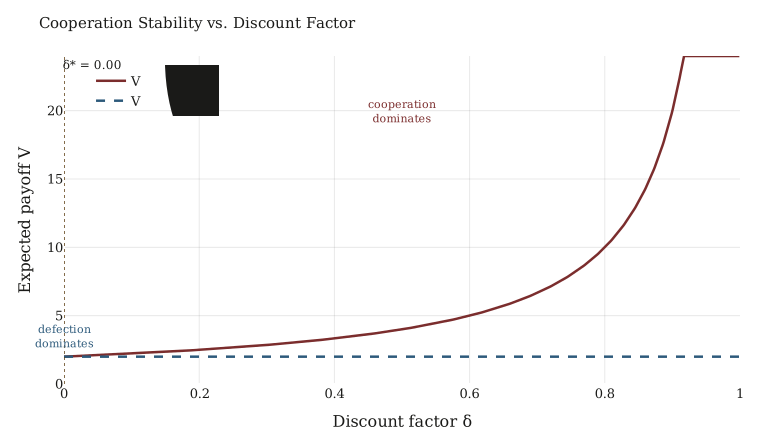
The diagram below plots the expected payoffs and against the discount factor .
At the two curves intersect. To the right of , patient agents prefer cooperation; to the left, short-term defection wins. For our reference parameters the crossover sits at .
Communication Capacity as Catalyst
Once cooperation is established it generates a second dynamic: a richer shared vocabulary lowers encoding costs and raises detection of deception. The interactive chart below traces how payoffs shift as communication capacity grows.
Drag the cursor over the chart to read precise values. The vertical marker shows , the threshold beyond which cooperation dominates even at moderate discount factors.
The Topology of Belief Space
There is a deeper geometric point lurking behind the payoff analysis. The space of communicable mental states is not Euclidean. Identifying indistinguishable states under the equivalence relation of pragmatic synonymy produces a quotient space with non-trivial topology.
The simplest compact non-orientable surface is the real projective plane . The Roman surface below is one classical immersion of in — realised via the map that collapses each pair of antipodal points on to a single point. The self-intersections along three line segments are not defects but signatures of non-orientability.
Whether the actual belief space of language users has this topology is an open empirical question. The visualisation serves as a reminder that the attractor argument requires a topology theorem, not just an economic one.
Phase Portrait of Cooperation Stability
The diagram below shows the advantage of cooperation across all combinations of patience and communication capacity , derived from a parameter sweep computed offline. Green cells indicate regions where cooperation wins; red cells where defection wins. The dashed boundary traces the critical patience threshold above which cooperation is always preferable. As increases, this threshold drops to zero — cooperation becomes the dominant strategy regardless of patience.
Vocabulary Growth as Network Formation
A communication network can be thought of as a graph whose edges represent active cooperative links. The animation below tracks how this network forms as shared vocabulary grows from zero to its equilibrium value. Agents begin as defectors or silent observers; as rises and cooperation becomes rational, edges appear and strategies shift from and toward .
Use the controls to step through frames manually or let the animation run. The transition from a sparse, defection-dominated network to a fully connected cooperative one mirrors the attractor argument: given sufficient communication capacity, cooperation is individually rational and structurally stable.